

SafePoint IT Named to the 2026 Inc. 5000 List
SafePoint IT has been named to the 2026 Inc. 5000 list, the annual ranking of...
Selecting an IT partner ranks among the most consequential decisions a business leader can make. The right managed service provider (MSP) transforms technology from a cost into a competitive weapon. However, choose the wrong one, and you get surprise invoices, sluggish support, and sleepless nights worrying about security gaps.
Whether you’re a CEO evaluating your first MSP or an IT director looking to upgrade from a vendor that’s outgrown its usefulness, we’ll share the thought process for identifying the best managed IT service providers.

According to Research and Markets, the global managed services market is projected to reach $430.56 billion in 2026, up from $390.21 billion in 2025. It’s also expected to expand to $704.2 billion by 2031. That’s a compound annual growth rate of 10.34%.
What’s driving this growth? Here are the key drivers:
The most successful managed service provider companies now differentiate themselves through specialization, AI-driven automation, and vertical-specific expertise. Generic solutions are dying.
Geography shapes service delivery in ways that remote-only providers often fail to acknowledge. Here is why businesses operating in Chicago should seek a local MSP provider:

The best IT managed services companies provide clear and itemized quotes that detail exactly what you pay for. They will also detail what falls outside the scope. Per-user pricing models generally offer the most predictability, covering support, security, and maintenance without nickel-and-diming.
Furthermore, ask for a line-by-line breakdown and watch for red flags. For instance, after-hours support billed separately, on-site visits with hourly rates, or vague project work that could mean anything.
A transparent provider walks you through their pricing structure during the sales process, not after you’ve signed.
The defining characteristic that separates best managed IT service providers from break/fix shops is being proactive. A reactive provider waits for your phone call when something breaks. A proactive partner focuses on threats and solutions before they become outages.
This means:
When evaluating providers, ask to see their monitoring dashboard. A sophisticated operation shows you real-time data on network health, response times, and incident trends.
Demand a written Service Level Agreement (SLA) that specifies response times for different priority levels. For instance, 15 minutes for system-down emergencies, four hours for critical issues, and next-business-day for standard requests.
Ideally, the SLA should also address resolution targets. That’s how quickly they fix problems, not just acknowledge them. Ask to see their actual performance data against these guarantees. The top managed service providers track these metrics obsessively and share them during quarterly reviews.
Look for providers who assign a dedicated account manager or virtual CIO (vCIO) who meets with you quarterly. That’s to review performance metrics, identify aging hardware, and align IT investments with business goals.
These Quarterly Business Reviews (QBRs) should examine ticket trends, security incidents, project roadmaps, and budget forecasts. If the provider only talks to you when something’s wrong, they’re managing tickets instead of your business.
Generalists solve general problems. Your business deserves specialists who understand your regulatory landscape, operational rhythms, and industry-specific software. For example, healthcare organizations need HIPAA expertise that goes beyond checkbox compliance. Financial services firms require FINRA and SEC readiness.
Manufacturing operations demand understanding of OT (operational technology) security and supply chain vulnerabilities. When evaluating managed service providers companies, ask for references from businesses in your industry.
It’s a good idea to request specific examples of how they’ve handled compliance audits, security incidents, or operational challenges similar to yours. Experience in your vertical translates to faster onboarding, fewer surprises, and confidence during regulatory scrutiny.
The best managed service provider packages add security as a foundational layer, not an upsell. A complete stack includes:
Ask specifically, “What cybersecurity tools are included in your base price?” If the answer requires a separate proposal, you’re looking at a vendor who profits from your vulnerabilities. True partners embed security so deeply that you don’t have to think about it.
Ethical providers confirm in writing that you own all data, administrative credentials, and network documentation. Furthermore, they commit to cooperation during transitions, thereby supplying your new provider with necessary information without obstruction.
Furthermore, they specify exactly how and when their monitoring agents will be removed from your systems. The best managed service providers don’t lock clients in through technical complexity or data hoarding. They retain clients by delivering value that makes leaving unappealing.
This question uncovers hidden IT support costs before they surprise you. The answer should include:
If the response starts with “basic antivirus is included, but advanced security is an add-on,” you’re looking at a provider whose business model profits from selling you protection against threats you shouldn’t face.
Technician-to-client ratios directly impact service quality. The industry benchmark for effective support sits at around 150 users per technician, or 8 to 12 clients per engineer. Higher ratios mean stretched resources, slower responses, and technicians who can’t develop deep familiarity with your environment.
Ask for this number directly. A provider who can’t answer or gives vague assurances about “scalable teams” may be operating with dangerously thin staffing. Your business deserves a partner with the capacity to respond when you need them most.
Staff turnover happens. The question reveals whether the provider builds systems or depends on individual relationships. Look for answers about centralized documentation, backup account managers already familiar with your environment, and knowledge transfer protocols that prevent institutional knowledge from walking out the door.
If the response focuses on how loyal their employees are or how unlikely turnover is, you’re hearing avoidance. Loyal employees leave for better opportunities, but professional MSPs plan for that reality and protect clients from its impact.
Size and industry alignment matter more than generic testimonials. A provider who serves manufacturers with 500 employees may struggle with a healthcare practice of 50 employees. Ideally, request three references from organizations comparable to yours. They should be similar in size, industry, and operational complexity.
Ask those references about response times, how the provider handled their most challenging incidents, and whether they’d re-sign today. If the provider hesitates, offers excuses about confidentiality, or can only provide references from dissimilar businesses, consider it a serious concern.
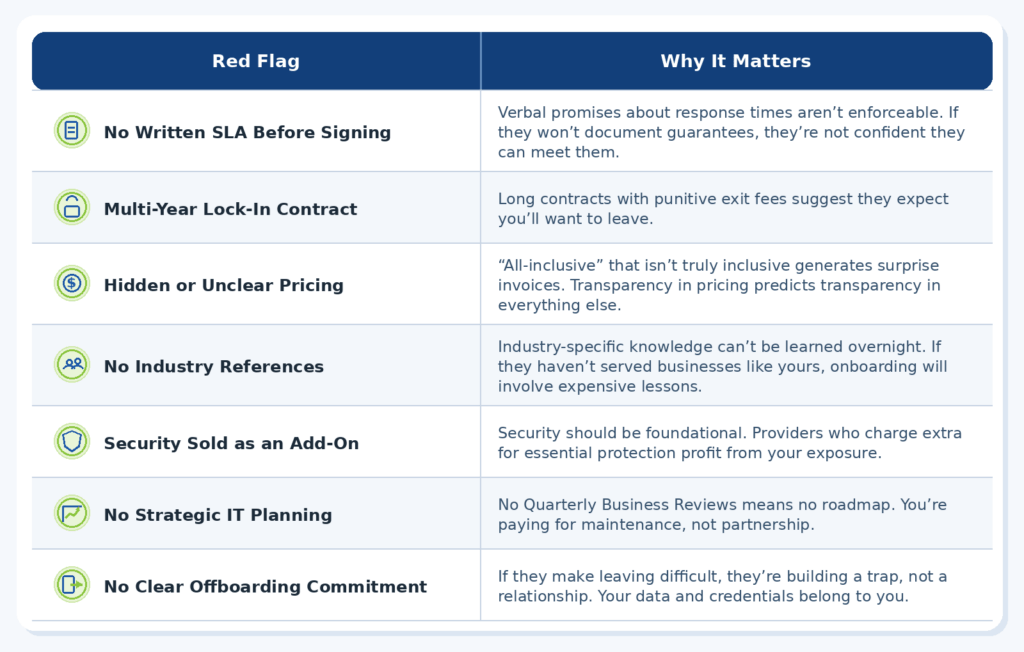
Here’s a table sharing managed service provider examples of red flags to avoid:
Choosing the right IT partner isn’t about finding the lowest monthly rate or the flashiest sales presentation. It’s about identifying a provider who treats your business goals as their own.
The criteria outlined here separate genuine partners from vendors who simply sell services. Therefore, ask the hard questions and verify the answers. Your business deserves nothing less than a partner who earns your trust every day.
At SafePoint IT, we built our practice around these principles. We’re Chicago-based, security-focused, and structured to act as your strategic technology partner. If you’re ready to discuss your needs, evaluate your options, and get a tailored quote, contact SafePoint IT to start the conversation.
Top IT managed service providers operate on a subscription model where you pay a predictable monthly fee for proactive monitoring, maintenance, and security. Break/fix charges hourly when something breaks.
The MSP’s incentive is preventing problems while break/fix profits from fixing them after disruption occurs.
Standard contracts range from 12 to 36 months, allowing providers to invest in onboarding and documentation. However, quality IT MSP companies often offer month-to-month options after an initial term or for clients who prefer flexibility. Always review termination clauses before signing.
A complete security stack includes Endpoint Detection and Response, email filtering, DNS protection, Multi-Factor Authentication, employee security awareness training, and 24/7 threat monitoring. If any of these require add-on fees, reconsider the provider’s approach to security.