

SafePoint IT Named to the 2026 Inc. 5000 List
SafePoint IT has been named to the 2026 Inc. 5000 list, the annual ranking of...
Every business leader fears the unexpected, such as a security breach, a server meltdown, or a compliance fine that could have been avoided. Yet most companies only investigate their vulnerabilities after something breaks. That’s when repairs are urgent, stressful, and expensive.
A risk review changes that equation entirely. It is a low-friction, and high-impact process that uncovers hidden threats to your revenue, operations, and reputation before they escalate.
In this guide, you will learn exactly what a business risk review evaluates, the five critical exposures it reveals, and why scheduling one is one of the smartest strategic moves you can make this year.

At its core, a business risk review is a structured and systematic evaluation of potential threats that could disrupt your operations, compromise sensitive data, or sink your profitability. Unlike a reactive break-fix approach that puts out fires after they start, this process identifies what could go wrong.
For example, an internal IT admin might miss a glaring security misconfiguration simply because they see it every day. That’s because familiarity breeds blindness. However, an external IT risk review brings fresh eyes. It represents a third-party assessment that can spot risks your internal team might have normalized.
By performing this deep scan, you shift from a reactive posture to a strategic one. It means you can avoid problems instead of waiting for them to happen before taking action.
A true proactive risk assessment peels back layers of complexity to reveal specific, actionable insights. Here is what a comprehensive evaluation uncovers.
Hackers scan for easy targets. A cybersecurity risk review reveals unpatched servers, missing multi-factor authentication, and weak password policies. You might discover that your firewall firmware has not been updated in 18 months or that former employees still have active login credentials.
According to the IBM Cost of a Data Breach Report 2025, the average breach now costs $10.22 million. A security gap review maps your exact exposure and prioritizes fixes. Without this view, you are flying blind into a storm of ransomware, phishing, and credential theft.
An operational risk review calculates your true recovery time and recovery point objectives. It checks whether backups exist, if they are tested, and whether they sit on the same server as live data (a common fatal error).
The ITIC 2024 survey found that 90% of enterprises lose at least $300,000 per hour of downtime. Your review will identify single points of failure before they trigger a costly, multi-day outage. This includes:
Data privacy laws are unforgiving. A risk and compliance review cross-checks your environment against standards like HIPAA, GDPR, or PCI-DSS.
Furthermore, it flags missing audit trails, improper data retention, and unencrypted storage. One oversight can trigger mandatory breach notifications, fines, and customer lawsuits.
For example, a Dutch business handling EU personal data without proper consent logs faces potential fines of up to €20 million or 4% of global turnover. A business technology assessment catches these blind spots early, turning a regulatory nightmare into a manageable checklist.
Old hardware and unsupported software can be a drag on your IT department. An infrastructure risk review catalogs every device and license. For instance, it finds:
This hidden technology risk evaluation exposes the true cost of keeping it running. You learn exactly how much productivity your team loses to slow logins, random crashes, and manual workarounds. Fixing these issues directly improves employee output and morale.
Your disaster recovery plan might not actually work. A business continuity review stress‑tests your response to real scenarios, including:
Many companies discover they have no written plan, or that the plan relies on a single employee who left six months ago. This section of a proactive risk assessment provides a step‑by‑step recovery playbook.
It also verifies offsite backups, alternate communication channels, and emergency vendor contacts. Therefore, when a crisis hits, you respond like a pro instead of a panicked amateur.
Below is a breakdown of exactly what a technology risk evaluation assesses, what it is likely to find, and the potential cost of ignoring the warning signs.
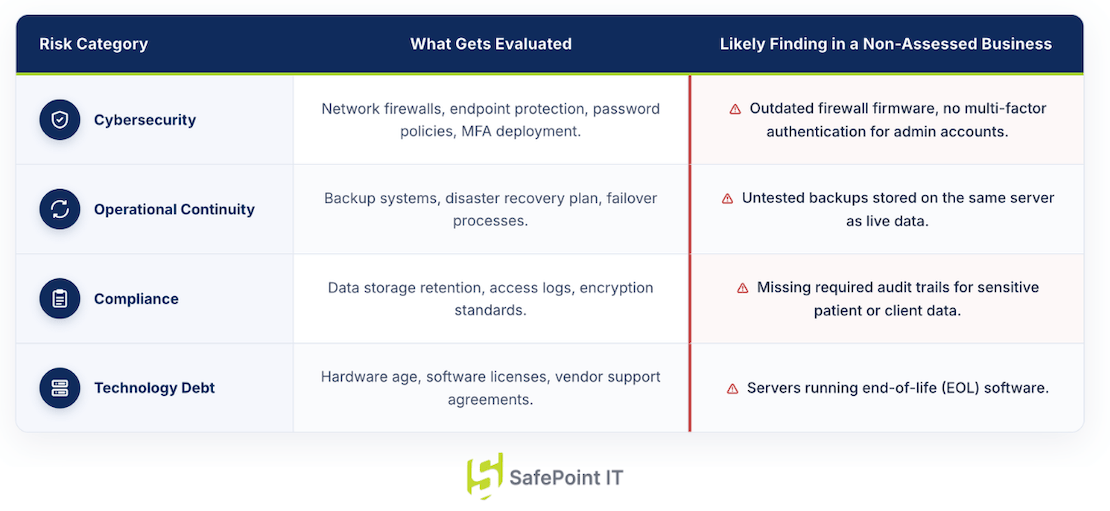
The hesitation to schedule an IT risk assessment usually comes down to cost. Business leaders ask, "Is it worth spending thousands on an assessment if nothing is currently broken?"
The answer requires a shift in perspective. The cost of a risk review is minuscule compared to the cost of a breach. A data breach can run into the millions. Compliance fines can sink a quarterly profit. Operational downtime can permanently damage customer relationships. Meanwhile, a comprehensive assessment by a qualified partner typically costs a fraction of emergency reactivation services.
Proactive repairs generally cost four to five times less than emergency repairs performed on the same asset. By capturing issues early, you distribute costs over time, avoid panic purchasing, and maintain leverage with vendors.
Furthermore, a business risk review serves as a strategic bargaining chip during cyber insurance renewal. Insurers increasingly require documented risk assessments and specific security controls before issuing favorable policies. Completing a review proves you are a lower liability, which lowers premiums and reduces the likelihood of coverage denials post-breach.
Demystifying the process reduces friction. A risk review is not a week-long intrusion, but a collaborative workflow designed for minimal disruption.
This low-friction approach respects your time and your operations. There's no need to shut down the business or dedicate weeks of internal resources.
You do not need a full-blown disaster to justify a second look. Watch for quiet but telling warning signs. For example, your IT budget keeps blowing up with emergency repairs, making financial planning a guessing game.
Also, employees have started using personal cloud drives or unapproved apps because the company system feels too slow or restrictive. Or, you cannot honestly remember the last time backups were tested, let alone successfully restored.
Another sign is when minor outages happen monthly, each one taking longer to resolve than the last. And if your compliance officer or auditor keeps flagging the same issues without real fixes.

A risk review is an investment in the longevity of your business. By proactively identifying business risks, you protect your revenue, reputation, and peace of mind. Also, you stop fighting fires and start building fireproof infrastructure.
Do not wait for a security incident or a major outage to justify the budget for a technology risk review. The businesses that survive are the ones that anticipate problems before they become headlines.
Take the first step toward risk-free operations. Contact SafePoint IT today to schedule a no-obligation business risk review. Let us show you exactly where your hidden exposures are and build a practical path toward complete digital resilience.
You’ll find that most assessments finish within one to two weeks. The hands-on work happens off-hours, so your daily operations continue uninterrupted. You receive a full report with prioritized fixes at the end of the process.
No, a risk review examines policies, hardware, and user behavior broadly. In comparison, a penetration test is a targeted simulation that actively tries to break into your systems. The review often recommends if and when a pen test is needed.
At least once per year. Also, schedule one after any major change, such as a new office, software migration, merger, or leadership shift. Regular reviews keep your security and operations aligned with business growth.
Not at all. The assessment runs in the background or during nights and weekends. Your team works normally. We coordinate directly with you to avoid peak hours. Zero interruption and full transparency.
You get a clear and jargon‑light action plan with costs and timelines. You decide whether your internal team handles the fixes or whether our team executes them. No pressure, just practical next steps.