

SafePoint IT Named to the 2026 Inc. 5000 List
SafePoint IT has been named to the 2026 Inc. 5000 list, the annual ranking of...
Choosing an IT support partner is one of the most underrated decisions a growing business makes. Pick the wrong one, and you get slow responses, surprise bills, and technology that holds you back. Pick the right one, and your systems become a launchpad for revenue, not a source of headaches.
This guide walks you through exactly what IT support services include, how providers differ from break‑fix to strategic partnership, and what red flags to avoid. Overall, you’ll learn how to evaluate managed IT support and compare service models.

You need to make an IT provider comparison, and the following points will help you narrow down the options.
A small business IT support partner that helps you grow starts by understanding your revenue model, customer journey, and three‑year vision. Furthermore, they ask about your growth targets, seasonal peaks, and compliance needs before mentioning servers or firewalls.
If the first conversation focuses on specifications instead of strategy, that’s a bad sign. The right provider will map every technical recommendation back to a business outcome. For example, that’s faster checkout, fewer support tickets, or a smoother audit next quarter.
Growth isn’t linear, since you may add thirty users one quarter and shift to a compliance overhaul the next. Your IT partner should let you add cloud infrastructure, security training, or after‑hours support without renegotiating your entire contract.
Fixed, rigid packages signal that the provider prioritizes their convenience over your changing reality. Look for:
A provider who has worked with logistics firms, professional services, or retail operations will anticipate your unique headaches. Ask for two case studies from businesses of your size in your sector.
Make sure to listen for specifics like “We helped Company X cut invoice processing time by 40%.” Also, industry‑specific knowledge means understanding your:
Transparency separates reliable partners from risky bets. A written Service Level Agreement defines guaranteed response times, escalation paths, and what happens when those guarantees are missed.
Fixed monthly pricing without surprise “per‑device” fees or emergency after‑hours charges is non‑negotiable. If a provider hesitates to share these documents upfront, walk away. A confident partner knows their SLAs and pricing are assets, not secrets. You should never sign a contract without seeing exactly what you’re buying.
Pricing for outsourced IT support varies based on scope, service level, and your technology stack. Most managed service providers charge a flat monthly fee per user or per device. That’s typically ranging from $75 to $250 per user per month.
Lower tiers include basic help desk and monitoring. Whereas higher tiers add strategic consulting, advanced security, and after-hours support.
For scalable support, avoid break-fix hourly rates ($125–$200 per hour) that become unpredictable as you grow. Furthermore, expect onboarding fees ($1,000–$5,000) for initial assessment and tool setup. The right investment usually lands between 2% and 6% of your annual revenue.
Cheaper options often hide costs through limited SLAs or reactive service. Transparent per-user pricing with clear inclusions gives you the predictability needed to scale confidently.
If a provider displays any of the behaviors below, trust your instincts and walk away before signing a contract.
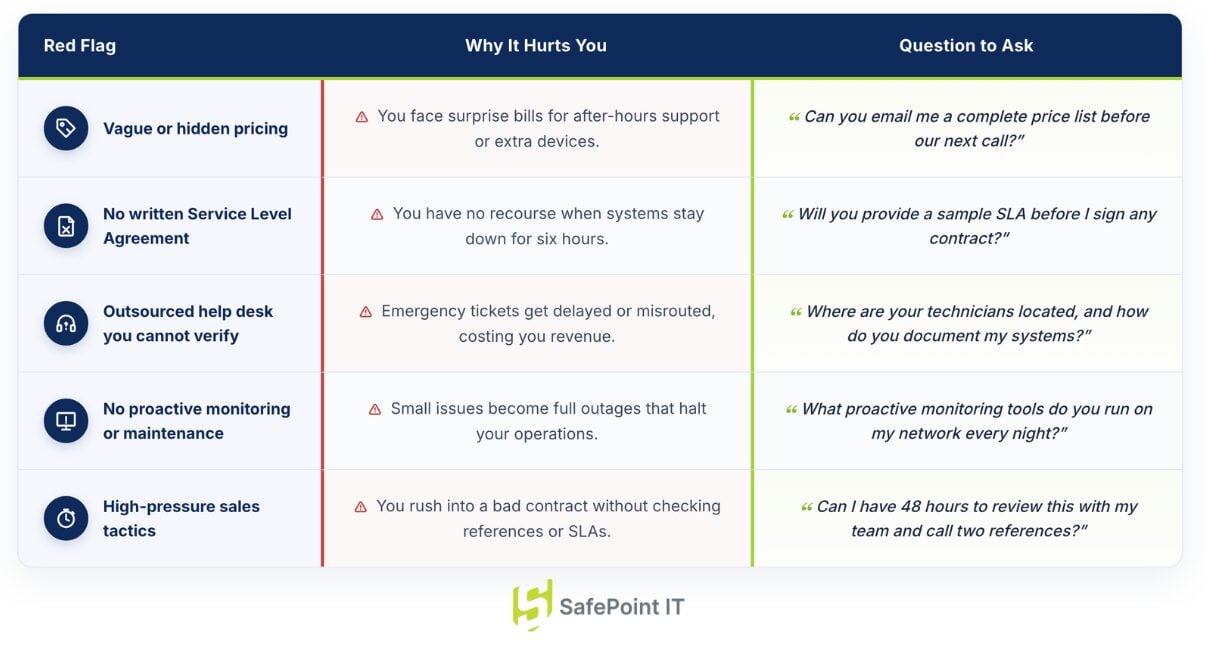
Providers fall into different categories. Break‑fix vendors charge hourly to repair problems after they occur. You pay more when things break, so their incentive is not aligned with your uptime. Managed IT support providers charge a flat monthly fee for proactive monitoring, help desk, and maintenance. They prevent issues before they start.
Strategic technology partners do all of that plus advisory services, which means IT roadmaps, security planning, and growth consulting. They attend your leadership meetings and connect technology decisions directly to revenue goals. Choosing the right model determines whether IT becomes a cost center or a competitive advantage.

Selecting an outsourced IT support partner is about finding a team that treats your technology as a strategic asset. The right provider prevents fires, plans for growth, and makes your team more productive. The wrong one adds another vendor to your already overflowing inbox.
At SafePoint IT, we don’t just monitor your systems. We monitor your goals, ask the hard questions, and build relationships. And we’re ready to show you what proactive IT support looks like when it’s done right. Contact SafePoint IT today to get started.