

SafePoint IT Named to the 2026 Inc. 5000 List
SafePoint IT has been named to the 2026 Inc. 5000 list, the annual ranking of...
Too many small business owners find themselves trapped in a cycle of emergency tech repairs, security scares, and productivity drains that larger competitors simply don’t face. This article explores a smarter path through managed IT services for small businesses by shifting from reactive firefighting to proactive IT management from a trusted provider.
By partnering with the right managed service provider, you gain enterprise-grade security, predictable costs, and a technology strategy that enhances business efficiency. It’s a more reliable approach to IT management that supports growth instead of distracting from it.

Managed IT services for small businesses is the practice of outsourcing day-to-day IT management and support to a specialized third-party provider. They are known as a Managed Service Provider (MSP). Think of it as having a dedicated and remote IT department that works exclusively for you, but without the cost of hiring a full-time staff.
Instead of waiting for a disaster to strike - a crashed server, a ransomware infection, a lost customer database - an MSP continuously monitors your network, endpoints, and applications 24/7.
Managed IT services for small business cover everything from cybersecurity and data backup to cloud infrastructure management and helpdesk support. The goal is to ensure your technology is always on, secure, and aligned with your business objectives. It’s a shift from paying for repairs to investing in performance.
To visualize the difference, consider how these two models stack up against the demands of a growing business.
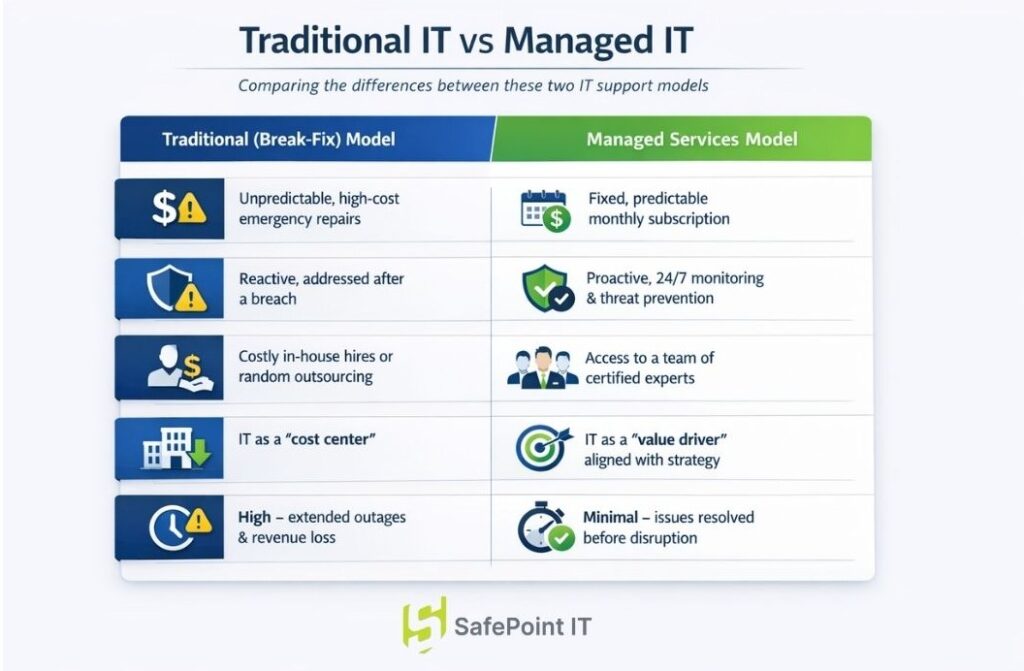
For the ambitious small business, competing with larger rivals often feels like an uphill battle. They have the budgets, the teams, and the proprietary systems. However, a strategic partnership with a managed service provider for small business is the great equalizer.
Few things disrupt a quarterly forecast like an emergency IT bill. In the traditional model, you bleed money on unexpected repairs, frantic hardware replacements, and lost productivity. In comparison, managed service providers for small business flip this model on its head.
They operate on a fixed monthly fee, consolidating unpredictable IT variables into a single, manageable line item. Therefore, you can allocate capital toward growth initiatives, marketing campaigns, or product development.
Cybercriminals are not just targeting the Fortune 500 since they view small businesses as soft targets. In fact, a significant portion of attacks now target SMEs, who often lack dedicated security personnel. Unfortunately, 73% of business owners share that employees don’t take cybersecurity threats seriously.
Managed services for small business bring military-grade defenses to your perimeter. We are talking about:
This proactive security posture means you are protected by systems and expertise that would otherwise be financially out of reach. It keeps your customer data safe and your reputation intact.
A managed IT partner deals with software patches, optimizes network devices, and ensures your internet connectivity runs at peak performance.
This translates directly to the user experience, thereby enjoying fewer glitches, faster load times, and zero downtime. When employees don't have to fight their tools, they can focus on their actual jobs - closing sales, delighting customers, and refining products.
Hiring a skilled IT security architect or a cloud engineer can cost six figures, and convincing them to join a small firm is even harder. When you engage in managed IT services for SMB, you inherit an entire team of certified experts.
You gain access to:
This collective brainpower becomes your on-demand resource, ensuring you never miss a beat due to a skills gap.
Perhaps the most underrated benefit is mental bandwidth for business leaders who are pulled in a thousand directions. When IT is a constant worry - a slow network here, a security alert there - it fractures focus.
By offloading the burden of IT management, you reclaim that cognitive real estate.
Therefore, you can step out of the weeds of daily tech fires and step back to the bigger picture. This means strategizing for the next quarter and innovating.

There is a pervasive myth among small business owners that paying for IT only when it breaks is the frugal choice. This break-fix approach is the business equivalent of ignoring your car's oil light until the engine seizes.
Here are the reasons why a proactive approach is save you money:
Not all IT support is created equal. To truly beat your competitors, you need a suite of services designed to enhance agility and resilience. Here are the core offerings that turn your MSP into a strategic weapon.
Technology never sleeps, and neither should your defenses. Around-the-clock network monitoring ensures that, whether it’s 2 PM or 2 AM, anomalies are detected and neutralized instantly.
This is paired with a responsive helpdesk that acts as your internal IT team. When an employee has an issue, they get immediate assistance rather than waiting days for a fix. This rapid response keeps workflows smooth and morale high. It goes a long way toward ensuring that minor glitches never escalate into major roadblocks.
In an era where a single data breach can shutter a small business, security is the foundation of trust. Your MSP should deploy a layered defense strategy, including:
Beyond just tools, this service includes critical employee training to spot phishing attempts, turning your staff into a human firewall. For firms in regulated industries, the MSP also ensures compliance with standards like PCI or HIPAA. It goes a long way toward protecting you from legal fallout.
Strategic consulting involves sitting with you to understand your business goals and then architecting technology to support that growth. This includes launching a new product, expanding to a new location, or acquiring a competitor.
Furthermore, they help you decide when to move to the cloud, what software stack will scale, and how to leverage AI tools. It’s about ensuring your technology spend drives revenue, rather than just supporting operations.
Ransomware and natural disasters are real threats. Therefore, a strong backup and disaster recovery (BDR) service ensures that if the worst happens, your business will not fall apart.
This involves automated & verified backups stored securely. That’s often in the cloud with a tested plan to restore operations quickly. While your competitor is scrambling to recover lost data for weeks, you are back online in hours. That’s important for preserving customer confidence and revenue streams.
Cloud infrastructure offers flexibility and scalability, but managing it can be complex. Your MSP handles the heavy lifting, which includes:
Additionally, they ensure your team can securely access the files and apps they need from anywhere. It enables hybrid work models that attract top talent. This service ensures you harness the full power of platforms like Microsoft 365 or AWS without the technical headache.
Selecting small business managed IT services is a decision that will ripple through every facet of your operation. Here are the key ideas to keep in mind during the selection process:

Small businesses can no longer afford to treat IT as an afterthought. It’s time to reframe technology not as a cost to be minimized, but as a strategic asset to be optimized.
By embracing managed IT services for small business, you are investing in agility, security, and peace of mind. You are choosing to let experts manage the digital machinery while you focus on leading your team. It’s time to ensure your technology gives you the edge you deserve.
Want to see what co-managed IT could look like for your team? Schedule a Discovery Call with SafePoint IT to talk through your current environment and where extra support would make the biggest impact.
Typically, a package includes 24/7 network monitoring, cybersecurity management (firewalls, antivirus, threat detection), data backup and disaster recovery, helpdesk support for employees, and software patch management.
Many providers also offer strategic consulting to align your tech with business goals.
No business is too small. In fact, startups and micro-businesses often benefit the most from small business IT managed services. That’s because they gain access to enterprise-level security and IT expertise without the six-figure salary of an in-house hire.
If you rely on email, customer data, or internet connectivity, you need the reliability an MSP provides.
Yes, and this is often called co-managed IT. The managed services provider for small business can handle the heavy lifting of 24/7 monitoring, advanced security, and evening on-call coverage, allowing your internal IT person to focus on strategic projects.
Instead of getting stuck handling routine tickets and reactive issues, your in-house IT lead gets the support they need to work more effectively and create more value across the business.