

SafePoint IT Named to the 2026 Inc. 5000 List
SafePoint IT has been named to the 2026 Inc. 5000 list, the annual ranking of...
It usually arrives as a spreadsheet attached to a routine email from purchasing. Eighty to three hundred rows. "Do you enforce multi-factor authentication for all remote access?" "Describe your incident response plan." "Provide evidence of annual penetration testing." Due in two weeks.
For a lot of owners, this is the first time IT stops being a cost line and starts deciding revenue. The customer isn't asking out of curiosity. Somebody above them (an auditor, an insurer, a regulator) is asking them about their suppliers, and you're one of the suppliers.
Five years ago, security questionnaires were mostly a big-company problem. Now they land on 30-person manufacturers, CPA firms and medical billing companies every month. The requests we see from clients and prospects look like this:
The pressure comes from rules that make companies responsible for their vendors. The FTC's Safeguards Rule requires financial institutions to oversee their service providers and require safeguards by contract. The SEC's amended Regulation S-P now requires investment advisers and broker-dealers to oversee vendors with access to customer information, and smaller firms had to comply by June 3, 2026. HIPAA requires business associate agreements. And for defense suppliers, phase two of the Department of Defense's CMMC program starts on November 10, 2026, when many contracts begin requiring third-party certification at award.
The result is the same for you: the questionnaire flows downhill until it reaches a company without a security team.
The formats vary (custom spreadsheets, portals, the industry-standard SIG and CAIQ templates, ISO 27001 annexes), but the substance repeats. Expect questions in these areas:
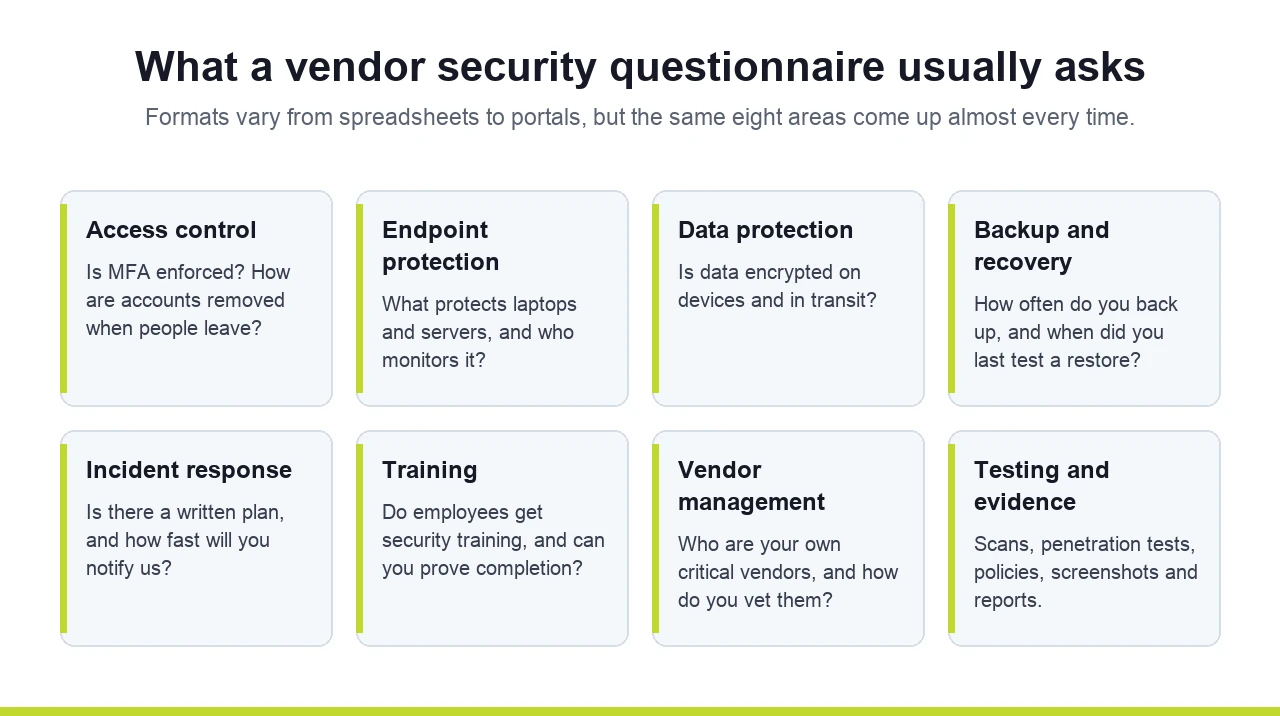
The quickest way to fill in a questionnaire is to answer yes to everything. It's also the riskiest.
A questionnaire answer is a representation to a customer, often attached to a contract. If there's a breach later and the answers don't match reality, the conversation stops being about the breach and starts being about what you told them. The same applies to cyber insurance applications, which ask many of the same questions and which carriers check after a claim.
We regularly see the gap between what a company believes and what's configured. MFA that's enrolled but not enforced. Training that was assigned but that most employees never completed. An "incident response plan" that's a vendor's phone number on a sticky note. None of these are unusual. They become a problem when they're written down as "yes."
An honest "partially, with a remediation date" is a far better answer than a "yes" you can't support. Most customers would rather see a plan than a perfect score.
Find out what's driving it. Ask your contact who requires the questionnaire and what a passing result looks like. Sometimes only a handful of questions are mandatory, and the rest are informational.
Answer from evidence, not memory. For each technical answer, have whoever runs your IT confirm it against the actual settings and reports. If nobody can show it, treat the answer as "no" for now.
Mark gaps with a date. "MFA is enforced for email; enforcement for the VPN is scheduled for completion by December 15" is a credible answer.
Keep a master copy. Most questionnaires ask the same 80 percent. Once you've answered one carefully, reuse it and keep it current. The second one takes an afternoon instead of two weeks.
Fix the cheap gaps first. Enforcing MFA, turning on disk encryption, removing old accounts and writing a one-page incident response plan close a large share of the "no" answers quickly.

The flip side is good news. When you can return a clean, honest questionnaire in a few days, you look like the safer supplier, and the customer's procurement team remembers it at renewal. For several companies we've worked with this year, a customer's questionnaire was what finally got their security in order.
When a client receives a security questionnaire, our engineers work through the technical sections with them and answer from what's configured in their environment, not from guesses. Where an answer is "not yet," we put a remediation plan and a date behind it. For prospects, a business risk review shows where you stand before the next spreadsheet arrives.
If a customer, insurer or regulator just sent you one and you're not sure how to answer it accurately, book a 15-minute call with our team. We'll tell you which questions matter most and what it would take to answer them with confidence.
Tell us a little about your business and we will get you booked in.