

SafePoint IT Named to the 2026 Inc. 5000 List
SafePoint IT has been named to the 2026 Inc. 5000 list, the annual ranking of...
Your law firm runs on trust, billable hours, and client secrets. But one phishing email, failed backup, or compliance blind spot can unravel all three in seconds. Most legal teams don’t lack technology, but they lack the right kind of IT support.
You’ll find that generalist providers miss legal-specific risks, and reactive break-fix models leave gaps until something breaks. And with cybercriminals now targeting mid-sized firms aggressively, standing still is dangerous.
In this guide, you will learn what strong legal IT services include, how to spot security holes, and what to demand from a managed IT partner before your firm pays the price for inaction.

Many firms assume IT support means someone shows up when something breaks. That’s like hiring a fire department that only arrives after the building has burned down.
Comprehensive legal IT support operates on an entirely different model. It’s proactive, predictive, and purpose-built for the unique demands of legal practice.
Technology doesn’t stand still, and neither should your firm’s approach to it. Strong legal managed IT begins with a thorough assessment of your current infrastructure, workflows, and pain points. Therefore, a strategic partner maps technology investments directly to business outcomes.
This means quarterly technology reviews, roadmap planning, and honest conversations about what’s working and what isn’t. It also means aligning your tech stack with your firm’s growth trajectory. That’s whether you’re opening a new office, adding practice areas, or preparing for acquisition.
Legal work doesn’t adhere to a 9-to-5 schedule. Neither should your IT support. For law firms that means help desk coverage through the business day, an on-call engineer for emergencies into the evening, and security monitoring that never stops.
But the real value isn’t just availability, but intelligence. The best support teams understand legal workflows intimately. They know that a problem with your legal software or Microsoft 365 for law firms is a direct hit to billable productivity. They resolve issues faster because they speak your language.
On-premise servers are expensive to maintain and they’re a liability. Fortunately, modern managed IT services for law firms prioritize cloud infrastructure that delivers enterprise-grade security without the hardware headaches.
This includes secure remote access for attorneys working from home, courthouses, or client sites. It means encrypted connections, legal document security, zero-trust network architectures, and continuous monitoring for unusual activity. Your network should be invisible to outsiders and seamless for your team.
Generalist IT providers often freeze when faced with legal-specific software. A legal technology support partner knows the ecosystem inside and out. They document management systems, practice management platforms, e-discovery tools, time and billing software, and the integrations that tie them together. When something breaks, they already know where to look.
Cybercriminals follow the money and the secrets, and Law firms hold both. From merger details to litigation strategies, your servers are a treasure chest.
Staying compliant is baked into your ethical obligations as legal professionals. But the regulatory landscape has grown increasingly complex, and the penalties for noncompliance have followed suit.
Compliance support for law firms covers several critical areas. First, data privacy regulations. If your firm handles EU client data, GDPR applies. This requires consent for processing, stringent access controls, and breach notification within 72 hours. If you work with protected health information, HIPAA demands encryption, audit logs, and access management.
Then there are ethical rules governing technology competence. Many state bars now require attorneys to understand the benefits and risks of the technology they use. That’s including AI tools, cloud storage, and client communication platforms.
A managed IT partner with legal expertise doesn’t just install software and walk away. They help you document compliance measures, maintain audit trails, and demonstrate due diligence should regulators come calling.

Not every managed IT provider understands the legal industry. Here’s what separates a true partner from a generalist vendor:
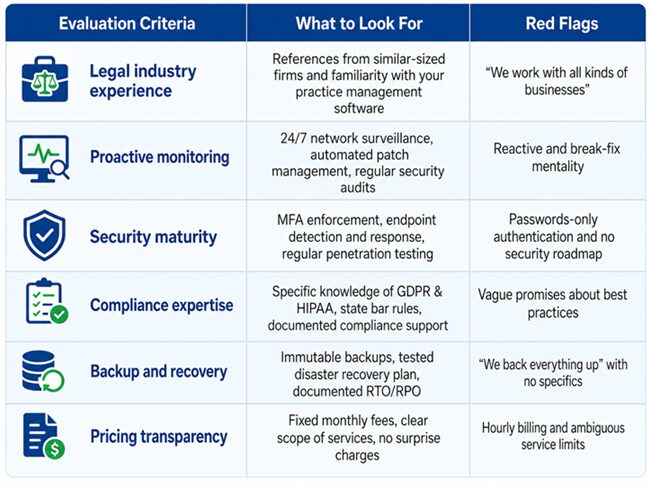
Your firm’s technology either amplifies your practice or undermines it. There’s no middle ground. Managed IT for law firms is a strategic investment in security, compliance, and operational resilience.
The right partner does more than keep the lights on. They help you work smarter, protect what matters most, and sleep better at night knowing your clients’ data is safe.
At SafePoint IT, we don’t just support legal technology. We become an extension of your team. That means a strategic partner who speaks your language, understands your risks, and proactively builds systems that work, so you can focus on practicing law.
Contact SafePoint IT today to schedule a consultation and see what proactive legal IT support actually looks like.